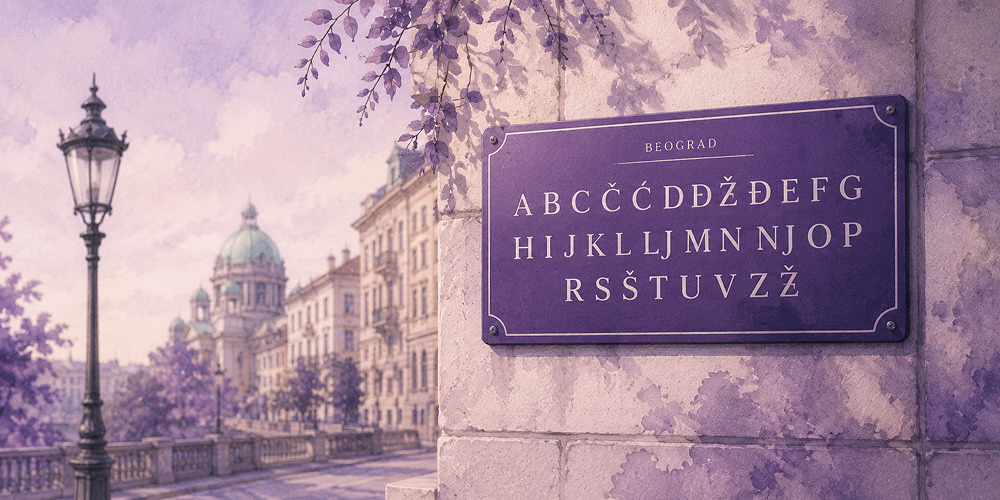
The Alphabet: Two Scripts, One Sound Each
By Glen Ranđelović Michaelsen
One of the first pleasant surprises when learning Serbian or Croatian is the alphabet. Unlike English — where through, though, and tough all treat "ough" differently — these languages are almost perfectly phonetic. Each letter represents exactly one sound, and each sound is written with exactly one letter. Once you know the letters, you can read any word out loud correctly, even if you have no idea what it means.
Two scripts
Croatian uses the Latin alphabet (latinica). Serbian uses both Cyrillic (ćirilica) and Latin interchangeably — you'll see both on street signs, in newspapers, and online. The good news: the two scripts map onto each other one-to-one. Learn the sounds once, and switching scripts is just swapping symbols.
The Latin alphabet
There are 30 letters. Most look familiar, but a few carry diacritics that change the sound:
- č — like the ch in "church"
- ć — a softer ch, closer to "tch" in "future"
- š — like sh in "ship"
- ž — like the s in "measure"
- đ — like the j in "jeans"
- dž — a harder j, like the j in "judge"
- lj — like the lli in "million"
- nj — like the ny in "canyon"
- c — always ts, like the end of "cats"
- j — always y, like in "yes"
Notice that dž, lj, and nj are written with two characters but count as single letters with a single sound.
Vowels are pure and consistent
There are five vowels — a, e, i, o, u — and they never change. They are always pronounced the same way, roughly:
- a as in "father"
- e as in "bed"
- i as in "machine"
- o as in "more"
- u as in "rule"
There are no silent letters and no long-vs-short spelling tricks. What you see is what you say.
Cyrillic, briefly
If you're focusing on Serbian, Cyrillic is worth learning early — it's not hard, because it's the same sound system. A handful of letters look like Latin ones and sound the same (а, е, о, к, м, т), a few are "false friends" that look familiar but sound different (с = s, р = r, н = n, в = v), and the rest are new shapes for sounds you already know (ш = š, ч = č, ж = ž).
Why this matters
Because the writing system is phonetic, reading and pronunciation are the same skill. You don't have to memorize how each word sounds separately from how it's spelled. Spend a few hours getting comfortable with the letters above, and you'll be able to sound out any word in the language — which makes everything that comes after, from vocabulary to grammar, noticeably easier.
Start by drilling the diacritic letters (č, ć, š, ž, đ) and the two-character letters (dž, lj, nj), since those are the ones that trip up English speakers. Everything else will feel natural within a day or two.